
What Does Your Love Triangle Look Like? A Therapist's Guide to Sternberg's Theory

In 1986, psychologist Robert Sternberg proposed something both simple and radical: that love isn't one thing: it's three. And the combination of those three elements explains almost everything about why some relationships thrive, some fade, and some leave us feeling quietly lonely even when we're not alone.
Sternberg's Original Vision: Love as a Triangle
Robert J. Sternberg was a cognitive psychologist at Yale University when he published his landmark paper in Psychological Review in 1986. He wasn't trying to write a self-help book, he was trying to bring scientific rigour to a concept that psychology had largely left to poets.
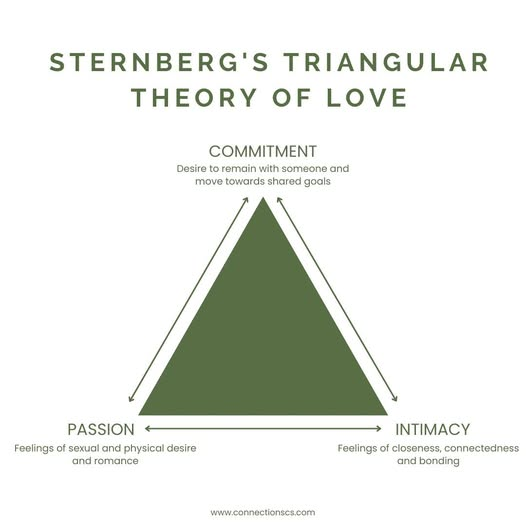
His central argument was this: love in close relationships can be understood through three distinct but interconnected components — intimacy, passion, and commitment — each forming a vertex of a triangle. The size of each vertex, and the balance between them, determines both the type of love present and the overall health and satisfaction of the relationship.
Crucially, Sternberg wasn't saying all three had to be equal. He was saying that understanding which components are strong, which are weak, and which are missing entirely is the key to understanding what's actually happening in a relationship and what might need to change.
Breaking down each component
Intimacy is often misunderstood. It is not primarily about sex, it is about emotional closeness. Sternberg described it as the feelings that promote bondedness and warmth: wanting to promote your partner's wellbeing, experiencing happiness with them, holding them in high regard, being able to count on them, sharing yourself with them, and receiving emotional support in return. Intimacy is the friendship at the heart of love and research indicates it forms a common core in all loving relationships, including those between parents and children, close friends, and romantic partners.
Passion encompasses the drives that lead to romance, physical attraction, and sexual connection. It is the component that tends to arrive fastest and fade soonest. Sternberg noted that passion is like an addiction in some ways, it is most intensely felt when new or at risk, and it can generate deep suffering when absent. Research indicates that physical attractiveness and sensual feelings are essential in early romantic love, and that sexual attraction often provides the motivational spark that kickstarts a romantic relationship.
Commitment is the cognitive component: the decision, first, that you love this person, and second, that you intend to maintain that love over time. It is the least glamorous of the three components and perhaps the most undervalued, yet research consistently shows it is a powerful predictor of long-term relationship satisfaction. Studies have found that all three love dimensions are positively correlated with marital satisfaction, and in some long-term relationship samples, commitment proves the most significant of the three.

The Eight Types of Love
Because any of the three components can be present or absent, Sternberg mapped out eight possible types of love, from the complete absence of all three (what he called non-love, the basis of acquaintanceship) to the presence of all three together. Here are the most relevant combinations:
Consummate Love
Intimacy + Passion + Commitment
The complete form of love. All three components are strong and balanced. Sternberg argues that couples must continue to put effort into each of the three components to maintain it, it is more challenging to maintain than to achieve.
Companionate Love
Intimacy + Commitment
Deep friendship and loyalty without physical desire. Common in long-term relationships where closeness and commitment remain strong, but physical intimacy has faded. Many couples remain very satisfied with companionate love.
Romantic Love
Intimacy + Passion
Emotional closeness and physical desire, but without a long-term commitment. Often characteristic of early relationships or affairs; intensely felt but structurally fragile.
Fatuous Love
Passion + Commitment
Commitment made on the basis of passion alone, without real emotional intimacy. Often called a "whirlwind romance": couples who escalate rapidly to serious commitment without truly knowing each other.
Infatuated Love
Passion Only
Pure physical desire and obsession without emotional closeness or commitment. Intense but unstable, what we sometimes call a "crush" or limerence.
Empty Love
Commitment Only
The decision to stay without either emotional closeness or desire. Often seen in relationships that have been deteriorating for years or in arranged marriages in their early stages.
Liking
Intimacy Only
Genuine closeness and warmth without passion or commitment. This is what we feel for close friends we do not love romantically.
Non-Love
None
The absence of all three components. This describes most casual interactions and acquaintances, people who are simply in each other's lives without meaningful connection.
From the Therapy Room: Why This Framework Is So Useful
As a couples therapist, one of the most common experiences in the therapy room is a couple who knows something is wrong but can't name it. They love each other, they're sure of that, but something feels hollow, or frantic, or absent. Sternberg's triangle gives us a shared language to begin locating exactly what's missing.
The framework is not a diagnostic tool. It is a map. And like any good map, its value lies not in telling couples where they should be, but in helping them understand where they actually are, without shame or blame, so they can figure out how to get where they want to go.
One of the most relieving moments in couples therapy is when partners realise that what they're experiencing (the flatness, the distance, the loss of spark) isn't a sign that love is gone. It's a sign that one corner of the triangle has been neglected. And neglected things can be tended to.
How the triangle shifts over time
Sternberg was clear that the triangle is not static. It changes, sometimes predictably, sometimes suddenly. In the early stages of a relationship, passion tends to dominate: the brain is flooded with dopamine and norepinephrine, everything is new and heightened, and commitment hasn't yet been established. Over time, passion naturally moderates. In healthy relationships, it is replaced and supported by deepening intimacy and a strengthening commitment.
The problem is that many couples interpret the natural decline of passion as evidence that the relationship is failing or that they've fallen out of love. This is one of the most damaging misunderstandings that brings people to therapy. Sternberg's framework helps couples see that this shift is normal, and that a quieter passion alongside deep intimacy and strong commitment is not a lesser form of love, it is a more mature one.

The triangle as a communication tool
In practice, one of the most powerful things about Sternberg's model is that it gives couples a non-blaming vocabulary to discuss what they're feeling, or not feeling. It is far less loaded for a partner to say "I think we've lost some intimacy lately" than "I feel like we're strangers." The first opens a conversation; the second can trigger defensiveness and shutdown.
In sessions, I often invite couples to independently rate their sense of each component on a simple scale, where do they feel their intimacy is right now? Their passion? Their commitment? Comparing those scores frequently reveals important discrepancies: one partner may feel the intimacy is strong while the other feels deeply disconnected. That gap itself becomes the therapeutic material.
When couples are in different "triangles"
One of Sternberg's most important observations, one that maps directly onto clinical practice, is that partners in the same relationship can be experiencing very different triangles. One person may feel profound intimacy and commitment while experiencing very little passion. Their partner may be burning with desire but feel emotionally disconnected and unsure about the future.
These mismatches are extraordinarily common, and they often go unspoken for years because each partner assumes their experience of the relationship is shared. One of the most useful things couples therapy can do is create the safety for these differences to surface, so that they can be worked with rather than silently tolerated or acted out.
What Consummate Love Actually Requires
Consummate love, the presence of all three components in balance, is the ideal relationship type in which a couple experiences friendship, physical desire, and long-term commitment simultaneously. It is what most couples want when they walk into a therapist's office. But Sternberg was honest about how difficult it is to achieve and, especially, to sustain.
The key word in his original work is effort. Love, in Sternberg's model, is not something that simply exists or doesn't. It is something that grows when it is tended, and fades when it is neglected. If one or two of the three dimensions are missing, a romantic relationship will not feel complete or satisfied. But the dimensions can be rebuilt through deliberate attention, practice, honest conversation, and, when needed, professional support.
This is, ultimately, the most hopeful aspect of Sternberg's framework: it tells us that love is not magic. It is not something that either exists or doesn't, unchangeable and opaque. It is a structure, and structures can be repaired.

Limitations Worth Acknowledging
As a practising therapist, I find Sternberg's model remarkably useful but I also think it's worth being honest about its limits. Research has shown that while the three dimensions of love are found cross-culturally, specific dimensions are differentially emphasised depending on whether a culture is individualistic or collectivistic. For example, in more collectivist cultures, commitment may be viewed as the bedrock of love from the outset, not something that develops after intimacy and passion.
The model also, by its nature, simplifies it all. Real relationships are messier than any three-component model can capture. Power dynamics, trauma histories, neurodivergence, cultural background, and the daily relentless grind of life all shape how love is experienced and expressed in ways the triangle doesn't fully account for. Understanding cultural layers allows couples to see that imbalances in intimacy, passion, or commitment are not necessarily personal failings, but rather can be the result of structural, cultural, and familial influences.
Used thoughtfully, as a lens, not a verdict, Sternberg's triangle remains one of the most accessible and clinically useful frameworks for helping couples understand what they have, what they want, and what work lies ahead.
A Final Word
Couples often arrive in therapy feeling like failures, like love has slipped through their fingers and they don't know why. One of the gifts of Sternberg's model is that it reframes that experience. It doesn't ask "do you still love each other?" in a way that demands a yes or no. It asks: what does your love look like right now? Which parts are strong? Which parts have gone quiet?
That is almost always a more productive question. Because in most cases, love hasn't gone. It has simply become unbalanced, tilted too far in one direction, or quietly starved in another. And understanding precisely where the imbalance lies is the first step toward doing something about it.

I am open to new clients!
I work with individuals and couples who experience relationship issues.
Get in touch to book a free phone consultation or an initial session.
References & Further Reading
Chojnacki, J. T. and Walsh, W. B., (1990). Reliability and concurrent validity of the Sternberg Triangular Love Scale. Psychological Reports, 67(1), 219–224.
Madey, S. F. and Rodgers, L., (2009). The effect of attachment and Sternberg's triangular theory of love on relationship satisfaction. Individual Differences Research, 7(2), 76–84.
Sorokowski, P. et al. (2021). Towards a Comprehensive Theory of Love: The Quadruple Theory. Frontiers in Psychology.
Sternberg, R. J., (1986). A triangular theory of love. Psychological Review, 93(2), 119–135.
Sternberg, R. J., (1988). The Triangle of Love: Intimacy, Passion, Commitment. Basic Books.
Sternberg, R. J., (1997). Construct validation of a triangular love scale. European Journal of Social Psychology, 27(3), 313–335.
Sternberg, R. J. and Weis, K., (Eds.). (2006). The New Psychology of Love. Yale University Press.


Comments